Rhinoplasty Morphing (digital rhinoplasty simulations) in Hampshire
Updated: Feb 4
With the rise of digital tools, many patients now ask whether they can see a “preview” of their rhinoplasty results using photo-morphing software. Online apps, filters, and 3D simulations make it seem easy to adjust the bridge, refine the tip, or straighten a deviation with a few clicks.
However, as a Consultant ENT & Rhinoplasty Surgeon in Hampshire, Southampton, Winchester and Portsmouth, I approach morphing with slight caution. While it can be a useful communication tool, it is also one of the most commonly misunderstood parts of rhinoplasty planning.
Here’s my balanced view on when morphing helps and when it can mislead.
Why Morphing Is Not as Simple as It Looks
Rhinoplasty is one of the most complex operations in facial surgery. Even small changes affect how other features look, and healing is never perfectly predictable.
Morphing software tends to oversimplify this.
For example:
Straightening the bridge also affects tip rotation.
Reducing a hump changes nasal length and support.
Refining the tip modifies the nasolabial angle.
Changing projection may alter valve function.
When multiple components of the nose are altered, the changes become even harder to simulate accurately. A morphed image may look appealing on screen, but that does not always translate to what is surgically achievable or what the patient will look like once swelling settles and tissues remodel over months.
For that reason, I don’t routinely morph images for every patient.
When I Do Use Morphing
If a patient is particularly keen to visualise potential changes, I am happy to provide carefully edited Photoshop images. These are intended as a concept, not a guarantee.They help patients understand broad goals such as:
reducing a dorsal hump
lifting a droopy tip
narrowing or straightening the bridge
balancing tip projection
improving symmetry
This can be especially useful for patients who struggle to describe what they want or who benefit from a shared visual reference when discussing surgical aims.
The Pros of Rhinoplasty Morphing
✔️ Helps clarify goals
Patients and surgeon can see whether they are aiming for the same aesthetic direction.
✔️ Useful for communication
It reduces ambiguity, especially around subtle details like rotation, projection and dorsal contour.
✔️ Enhances patient confidence
Seeing a conceptual outcome can help patients feel more prepared for surgery.
✔️ Allows discussion of limitations
Morphing can reveal why certain “Instagram nose” requests are not structurally or naturally achievable.
The Cons of Rhinoplasty Morphing
✖️ Can create unrealistic expectations
Some patients view the morphed image as a promise rather than a guideline.This is why I emphasise that morphs are not predictions.
✖️ Software cannot simulate healing
Scar tissue, swelling patterns, cartilage memory and individual anatomy all affect the final shape, none of which can be modelled perfectly.
✖️ Multiple changes are difficult to portray accurately
When altering several parts of the nose, morphing can oversimplify complex interactions.
✖️ Risk of disappointment if treated as exact
A 2D image cannot capture 3D structure, light, skin thickness or asymmetry.
My Approach: Realistic, Honest and Anatomically Grounded
For most patients, a detailed consultation, examination and explanation provide a far more accurate understanding than digital imaging alone. Especially, combined with high quality photos with detailed explanations.
But for those who find it helpful, I provide carefully moderated morphs created in Photoshop — always accompanied by a clear discussion about what is possible, what is predictable, and where results may vary.
Summary
Morphing can be a helpful communication tool in rhinoplasty but only when used responsibly. It is not a promise, not a guarantee, and not a replacement for surgical expertise, healing behaviour and anatomy.
At Adnova Clinic in Fareham, my focus is always on natural, functional, stable results rather than digital perfection.
If you are considering rhinoplasty or septorhinoplasty in Portsmouth, Southampton, Winchester or across Hampshire, I’m happy to discuss your goals, with or without morphing.
To enquire or book an assessment:
📍 Adnova Clinic
More information:
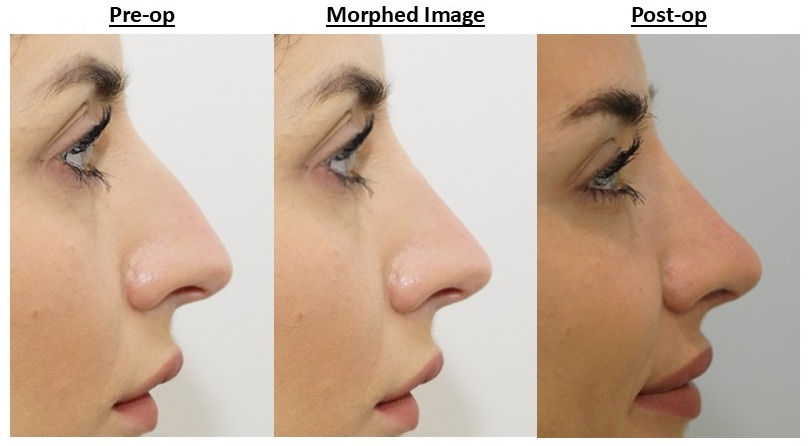
Rhinoplasty morphing example: Notice the effect the Rhinoplasty has on the improvement of the lip to nasal tip complex, in the real post-op compared to the Morphed image. The morphed image gives a representation, but the real post-op image gives a much more harmonised result.
Rhinoplasty Morphing & Digital Previews – Frequently Asked Questions (FAQ)
Can I see what my nose will look like before rhinoplasty?
Many patients ask whether they can see a preview of rhinoplasty results using photo-morphing or digital simulation. The honest answer is: yes, sometimes — but with important limitations. Morphing can be a communication tool, not a prediction or guarantee of outcome.
What is rhinoplasty morphing?
Rhinoplasty morphing involves digitally adjusting photographs of your nose (usually using Photoshop or specialist software) to illustrate potential changes such as:
Reducing a dorsal hump
Refining or lifting the nasal tip
Straightening a crooked nose
Adjusting projection or rotation
Improving overall balance and symmetry
It creates a concept image to help discuss goals — not a surgical blueprint.
Is rhinoplasty morphing accurate?
No digital morph can be fully accurate.
Morphing software cannot account for:
Swelling patterns over 6–12 months
Scar formation and tissue healing
Skin thickness and elasticity
Cartilage memory and long-term support
Subtle asymmetries and light reflection
Changes in breathing or nasal valve dynamics
This is why morphed images should never be interpreted as a promise of the final result.
Why don’t all surgeons offer routine morphing?
Because morphing is one of the most misunderstood aspects of rhinoplasty planning.
When treated as a guarantee, it can:
Create unrealistic expectations
Lead to dissatisfaction despite good surgery
Shift focus away from anatomy and function
Encourage trend-driven or unsafe requests
For this reason, Mr Tim Biggs does not routinely morph every patient, and uses it selectively where it genuinely adds value.
When can rhinoplasty morphing be helpful?
Morphing can be useful when:
A patient struggles to describe what they want
Subtle differences in tip rotation or projection need clarification
The goal is to align expectations, not dictate outcomes
Discussing why certain “Instagram noses” are unrealistic or unsafe
In these situations, carefully moderated Photoshop morphs may be used as a shared visual reference — always alongside detailed explanation.
What are the benefits of rhinoplasty morphing?
✔️ Improves communication between patient and surgeon✔️ Helps clarify aesthetic direction✔️ Allows discussion of limitations and trade-offs✔️ Can reduce misunderstanding before surgery
Used correctly, morphing can support better decision-making.
What are the risks of relying too heavily on morphing?
✖️ Unrealistic expectations✖️ Disappointment if results don’t exactly match a 2D image✖️ Over-focus on millimetres rather than overall balance✖️ Ignoring long-term function and stability
A rhinoplasty that looks good on screen may not be surgically achievable — or safe.
Is 3D rhinoplasty simulation better than 2D morphing?
3D imaging can be helpful in selected cases, but it still cannot predict healing or long-term results.
Both 2D and 3D systems are limited by:
Assumptions about tissue behaviour
Idealised symmetry
Absence of real post-operative biology
Technology does not replace surgical judgement.
How does rhinoplasty planning work without morphing?
For most patients, planning is best guided by:
Detailed facial and nasal analysis
High-quality clinical photography
Assessment of structure, support and airflow
Clear explanation of realistic change
Discussion of priorities: function, balance, longevity
This approach is often more accurate than relying on digital images alone.
What is your overall approach to rhinoplasty morphing?
At Adnova Clinic, morphing is:
Optional, not routine
Used selectively, not automatically
A guide, not a guarantee
Always accompanied by honest discussion
The priority is natural, functional, stable results, not digital perfection.
Key takeaway: Should I ask for rhinoplasty morphing?
You can — but you should understand what it is and what it is not.
Rhinoplasty morphing:
❌ Is not a promise
❌ Is not a prediction
❌ Is not a substitute for expertise
✔️ It can be a useful communication tool when used responsibly.
